


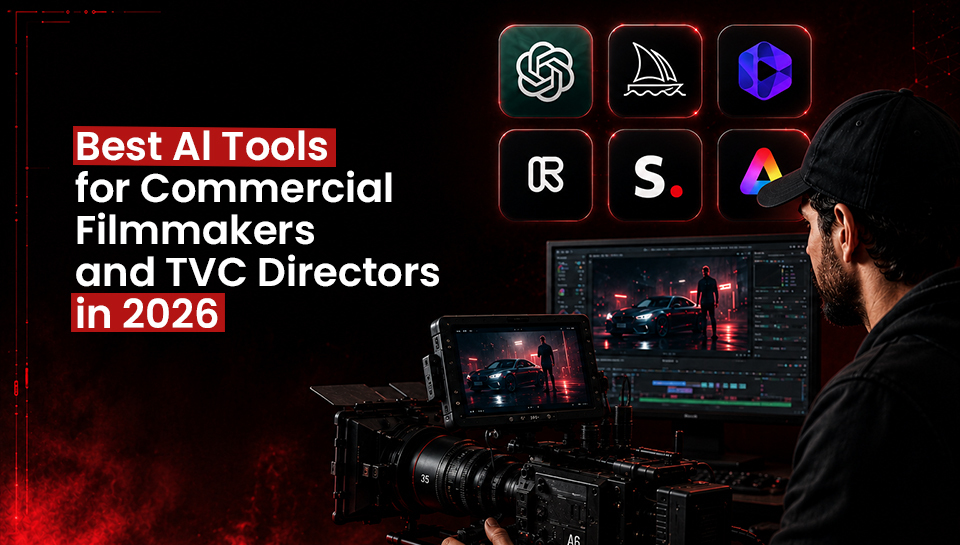
The camera still rolls. The director still calls it “action.” But something has fundamentally changed between the idea and the final cut. AI tools for commercial filmmakers are no longer experimental. In 2026, they are embedded in commercial production workflows, from concept development to post-production.
The directors leading today are not defined by budget, but by how effectively they integrate AI into their creative process. The rise of the AI Filmmaker marks a shift where storytelling meets intelligent production systems.
Why AI Is Transforming Commercial Filmmaking in 2026
AI is redefining how commercials are planned, produced, and delivered. Brands demand cinematic quality, faster turnaround, and scalable production — all at once.
This shift is powered by machine learning, generative AI, and automation in filmmaking.
- Faster production timelines (30–50% reduction)
- Scalable creative output
- Cost-efficient production workflows
- Enhanced visual storytelling capabilities
AI enables high-performance TVC production without compromising creative quality. It transforms production from a linear process into a flexible, intelligent system.
AI Tools for Scriptwriting and Concept Development
AI enhances creative ideation, scriptwriting, and narrative exploration. It allows filmmakers to test multiple concepts quickly and refine brand messaging with clarity.
Tools:
- ChatGPT (OpenAI)
- Sudowrite
These tools support creative direction, campaign ideation, and storytelling frameworks, helping the AI Filmmaker move from idea to execution faster while maintaining narrative control.
AI Storyboarding and Pre-Visualization Tools
Pre-visualization is critical for aligning creative vision with production execution. AI tools now enable real-time visual development, cinematic referencing, and mood creation.
Tools:
- Midjourney
- Stable Diffusion
- Flim.ai
- ShotDeck
- Runway ML
These tools strengthen visual storytelling, shot planning, and concept visualization, making it easier to present ideas within AI filmmaking services workflows and streamline TVC production planning.
AI Video Generation and Editing Tools
AI-powered video tools optimize editing workflows, visual enhancement, and content generation. They reduce manual effort while increasing creative flexibility.
Tools:
- Runway Gen-4
- Sora (OpenAI)
- Adobe Premiere Pro (with Adobe Firefly)
- DaVinci Resolve
- Topaz Video AI
- Descript
These tools improve video editing automation, color grading, scene detection, and dialogue editing, enabling faster delivery within film production services while maintaining professional quality.
AI Tools for VFX, Motion Capture, and CGI
AI is transforming visual effects, CGI production, and motion capture by making them more accessible and efficient.
Tools:
- Wonder Studio
- Move.ai
- Rokoko
- NVIDIA Omniverse
These tools support virtual production, real-time rendering, and digital character integration, expanding the creative possibilities of modern AI filmmaking services.
AI Voice, Music, and Dubbing Tools for Commercials
Audio plays a crucial role in brand storytelling and emotional engagement. AI simplifies the creation of voiceovers, music, and multilingual content.
Tools:
- ElevenLabs
- Papercup
- Soundraw
- AIVA
- Adobe Podcast
These tools enable AI voice generation, music composition, audio enhancement, and dubbing, supporting scalable and localized TVC production.
How AI Filmmakers Use AI Strategically
An AI Filmmaker uses technology not as a shortcut, but as a strategic advantage.
AI enables:
- Faster concept validation
- Stronger pitch presentations
- Efficient production planning
- Scalable creative output
The real advantage lies in reallocating saved time and budget into brand storytelling, casting, lighting, and cinematic direction. This is where human creativity continues to lead.
Balancing AI and Human Creativity in TVC Production
AI supports execution, but it does not replace creative intuition, emotional storytelling, or cinematic judgment.
It cannot:
- Understand emotional nuance
- Make instinct-driven creative decisions
- Replace human storytelling experience
AI enhances production efficiency, but the director defines the vision. The balance between both defines the future of film production services.
The Future of AI-Driven Commercial Production
The future of AI in filmmaking includes:
- AI-powered video personalization
- Real-time adaptive commercials
- Virtual actors and environments
- Scalable content generation
Commercial automation will absorb repetitive tasks. What it cannot replace is the AI Filmmaker who understands what a brand feels like and translates that into a compelling visual experience.
Final Thoughts
AI filmmaking tools are not changing what great filmmaking is. They are expanding what is possible.
The next generation of directors will succeed by combining:
- Human creativity
- AI-powered production
- Strategic storytelling
The future belongs to creators who understand both cinematic language and intelligent systems — and know exactly when to rely on each.
FAQs
What are the best AI tools for filmmakers in 2026?
The best AI tools for filmmakers in 2026 include ChatGPT and Sudowrite for scriptwriting, Midjourney and Runway ML for storyboarding, Runway Gen-4 and Adobe Premiere Pro for video editing, and ElevenLabs and AIVA for voice and music generation. These tools help AI Filmmakers improve efficiency, creativity, and production quality.




2 Comments
bdvegastars
October 15, 2026The mobile experience is incredibly polished and I never had to deal with any lag during my sessions. Bonuses are straightforward and the game catalog covers all the classics plus some exciting new releases. Definitely my current favorite platform. bdvegastars
brbbttbet
October 27, 2026As a big fan of live matches I needed a platform that could keep up with the action and this one delivers every time. The live streaming quality is top notch and the odds are always competitive. I also appreciate how smooth the cash out feature works when I need it. Definitely my go to for sports and casino games now. brbbttbet