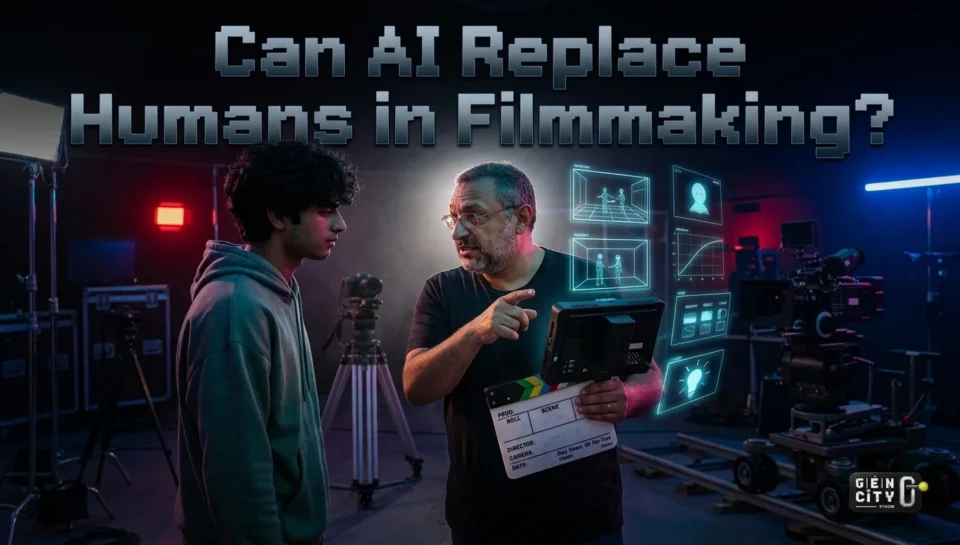
Artificial intelligence is changing filmmaking faster than many expected. Today, AI filmmaking tools can generate characters, environments, cinematic shots, voices, storyboards, and even complete sequences from simple prompts. This raises an important question: Can AI replace humans in filmmaking?
The short answer is more complicated than yes or no. AI can automate and accelerate many parts of AI film production, but filmmaking is not only about generating images or video. It is also about deciding what a story means, how a character should feel, which shot belongs in the final film, and when a scene needs silence instead of another visual.
For Sibghat Shaikk this distinction is at the center of exploring what generative AI can actually do in filmmaking.
AI Has Changed What Filmmakers Can Create
Generative AI has changed the filmmaking workflow by making visual experimentation faster and more accessible.
An AI filmmaker can develop a concept, explore different visual styles, create storyboard ideas, generate environments, produce video clips, experiment with characters, and test scenes without following the same production process traditionally required for every visual experiment.
This does not mean traditional filmmaking has disappeared. Instead, AI in filmmaking has introduced another layer between an idea and the final production.
A filmmaker can now move from an idea to a visual possibility in minutes. The challenge then becomes deciding which possibility actually serves the story.
That is where direction becomes important.
Generating a Shot Is Not the Same as Directing a Film
AI video generation can create impressive individual shots. But a film is not simply a collection of impressive shots.
A director has to understand the relationship between scenes, characters, pacing, emotion, camera movement, performance, sound, and story. One shot may look beautiful but still be wrong for the scene.
The same principle applies to AI-generated films. A model can generate possibilities, but someone still needs to select, refine, reject, connect, and direct those possibilities.
The important shift is therefore not necessarily AI vs human filmmakers. It is about how filmmakers use AI as part of a broader creative workflow.
What AI Can Already Do in Filmmaking
Concept Development
Generative AI can help filmmakers explore visual concepts before production. Different characters, locations, moods, compositions, and cinematic directions can be tested quickly.
Visual Development
AI image and video tools can help create visual references, character concepts, environments, and production ideas. This can make early creative experimentation much faster.
Storyboarding and Previsualization
AI can assist with turning written ideas into visual sequences. Filmmakers can use generated imagery to understand how a scene might look before developing the final version.
AI Video Generation
AI video generation is one of the most significant developments in modern filmmaking. Tools can create short cinematic sequences from text or visual references, allowing creators to experiment with movement, environments, characters, and camera ideas.
Environments and World Building
Generative AI can create locations that would otherwise require sets, locations, visual effects, or extensive production resources. This opens new possibilities for independent filmmakers and experimental projects.
Editing and Post-Production Assistance
AI can also support parts of editing, enhancement, audio, visual effects, and other post-production processes. These tools can reduce repetitive work and allow filmmakers to spend more time on creative decisions.
Commercial Content and Advertising
For commercial filmmaking, TVCs, and brand films, AI can help teams explore concepts, create visual treatments, produce variations, and develop advertising ideas more efficiently.
But efficiency is not the same as creative direction.
What Still Requires Human Direction?
Story
A film needs a reason to exist. AI can help generate story ideas, but the filmmaker decides what the audience should experience and why the story matters.
Creative Intent
Every creative decision communicates something. A director determines the tone, atmosphere, rhythm, visual identity, and emotional purpose of a scene.
Performance
One of the most interesting questions in AI filmmaking is whether AI-generated characters can deliver performances that feel human.
A visual can look realistic without feeling emotionally convincing. A character may smile, but does the smile arrive at the right moment? Does a pause feel intentional? Does a reaction communicate something without dialogue?
These questions become especially important when AI is used for acting and character performance.
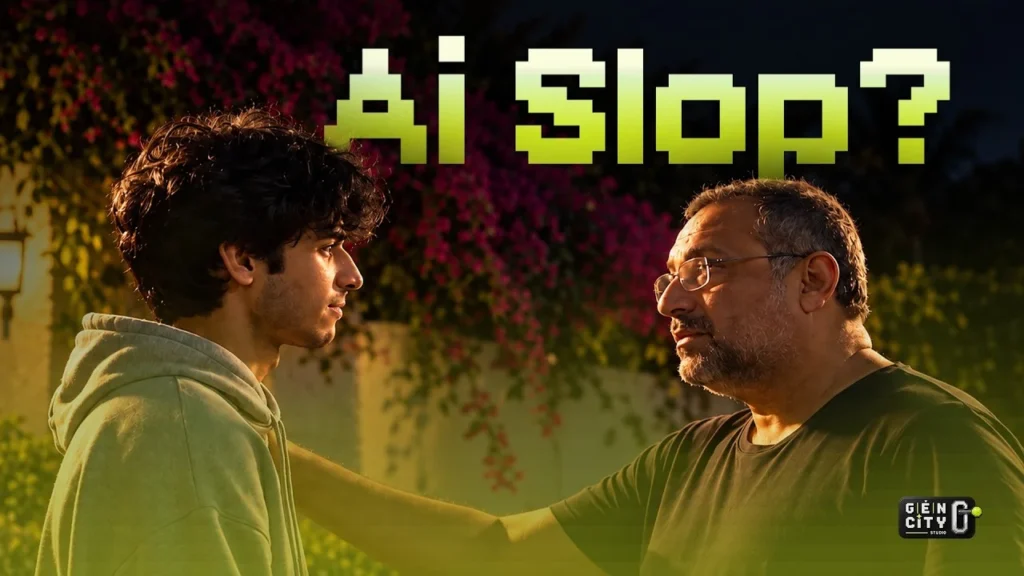
Sibghat Shaikh explored this idea through an AI-generated film experiment focused on performance and emotion. The experiment asks viewers to look beyond impressive visuals and consider whether AI can communicate emotion through timing, expression, silence, reaction, and character direction.
The central idea is simple: everyone can generate, but not everyone can direct.
The experiment explores whether an AI-generated character can act, whether generative AI can communicate emotion, and how much creative direction is required to make an AI-generated performance feel meaningful.
Shot Selection
AI may generate many possible shots, but a filmmaker must decide which one works.
Sometimes the strongest shot is not the most visually impressive one. It may be the quieter shot, the longer pause, or the composition that supports the character rather than distracting from it.
Visual Language
Directors develop visual languages through framing, movement, lighting, pacing, composition, and repetition. AI can help produce these elements, but human judgment still determines how they work together.
Editing
Editing is also about meaning. Choosing when to cut, when to hold a shot, and what to remove can completely change how an audience experiences a scene.
Cultural Context
A major advantage of human filmmakers is their understanding of people, places, culture, humor, behavior, and lived experience.
An AI-generated image of Karachi may look convincing, but understanding what makes Karachi feel like Karachi requires more than visual accuracy. It requires cultural context.
The New Role of the AI Filmmaker
The rise of generative AI is creating a new type of creative professional: the AI Filmmaker.
This role combines traditional filmmaking skills with AI tools and creative technology. An AI filmmaker may work across storytelling, film direction, visual development, AI video generation, editing, production, and creative experimentation.
The filmmaker is no longer only responsible for creating individual production elements. They increasingly become the person who directs an AI-assisted creative system.
The technology generates possibilities. The filmmaker gives those possibilities meaning.
What Sibghat Shaikh’s AI Filmmaking Experiments Reveal
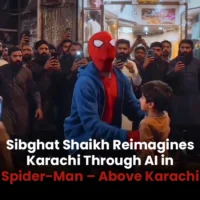
One example is Spider-Man – Above Karachi, an AI-generated short film that reimagines Peter Parker and Spider-Man within Karachi.
Instead of placing the superhero in New York, the project explores what Spider-Man might look like if his world were shaped by Karachi.
The production involved building a story around the city, generating numerous visual sequences, maintaining character and environmental consistency, and selecting the shots that worked together as a film.
The project became an experiment not only in AI video production, but also in directing AI-generated material.
The process demonstrates an important reality of generative filmmaking: producing one impressive image is relatively different from building a coherent film across many scenes.
Consistency, storytelling, shot selection, pacing, and creative judgment remain major parts of the workflow.
AI Can Generate Possibilities. The Filmmaker Chooses the Story.
So, can AI replace filmmakers?
AI can replace or automate certain production tasks. It can make some processes faster, reduce repetitive work, and allow individuals to experiment with visuals that once required larger teams and budgets.
But filmmaking involves more than production tasks.
A film director decides what the audience should see, what they should feel, what a character should communicate, and what should remain unsaid.
That means the future of filmmaking may not be about AI replacing humans. It may be about filmmakers becoming better at directing AI.
What AI Means for the Future of Film Direction
As AI tools become more capable, filmmakers may spend less time manually creating individual production elements and more time on creative direction.
The future AI filmmaking workflow could involve a continuous cycle:
Idea → Generation → Selection → Direction → Refinement → Editing → Story
AI can accelerate the generation stage. Human filmmakers remain responsible for turning those generated possibilities into a meaningful creative experience.
This changes the role of the filmmaker, but it does not remove the need for one.
The Future May Be Human + AI, Not Human vs AI
The most useful way to understand AI filmmaking is not as a competition between technology and creativity.
AI is becoming another filmmaking instrument.
Cameras changed filmmaking. Digital editing changed filmmaking. Computer-generated imagery changed filmmaking. Generative AI is creating another major shift.
The technology may continue to improve, but the fundamental creative question remains:
What story are you trying to tell?
AI can generate the possibilities. A filmmaker decides which possibilities deserve to become a film.
For creators like Sibghat Shaikh, the emerging opportunity is not simply to generate more content. It is to explore how AI filmmaking, film direction, cinematic storytelling, and human creativity can work together to create something that could not have existed in the same way before.