


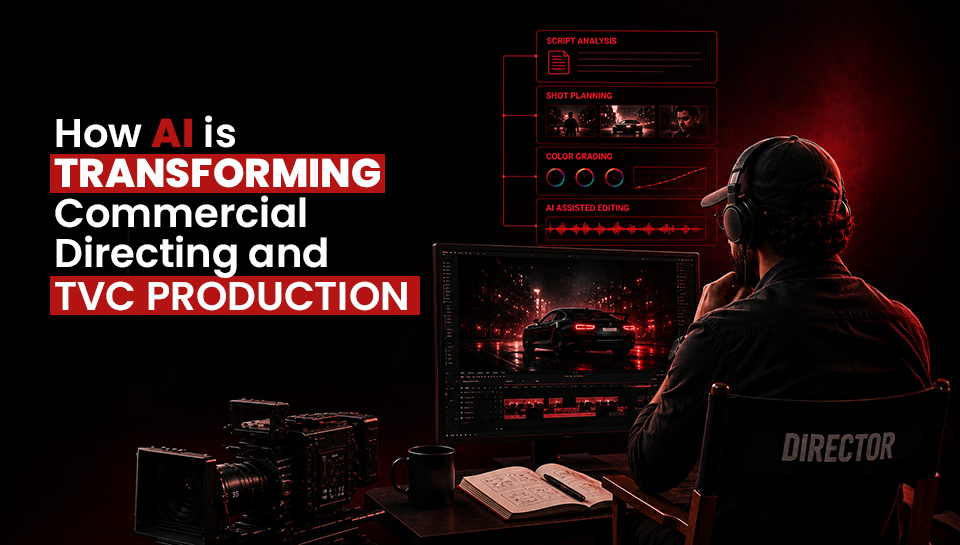
There is a version of this conversation happening in every production office, every agency, and every director’s edit suite right now. Should we use AI on this? How much? Where does it help and where does it hurt? The answers are still being worked out in real time. But one thing is no longer up for debate: AI in commercial filmmaking has moved from a novelty to a working reality, and the productions that understand it are pulling ahead. This is not about replacing the craft. It is about what happens when the craft gets access to better tools.
The Evolution of Commercial Production in the AI Era
For decades, the production workflow of a TVC followed a fairly fixed structure. Brief, concept, boards, shoot, edit, grade, deliver. Each stage had its own specialists, its own timeline, and its own budget line. The process worked, but it was slow and expensive by design. Generative AI is now restructuring that entire sequence. Roughly 30 percent of ads, social videos, and online content in 2025 were built or enhanced using generative AI tools, a figure expected to climb significantly through 2026.
That is not a trend forming on the edges. That is the center of the advertising industry shifting. For the UAE advertising industry, this is especially significant. Dubai’s video marketing ecosystem is uniquely positioned for AI adoption, backed by smart city initiatives and AI-first government policies. The UAE Government Media Office has already backed a million-dollar award for AI-generated short films in partnership with major technology platforms, recognizing productions built entirely through AI from ideation and storytelling through to post-production. The signal from the top is clear.
In Pakistan, where production budgets have always demanded creative efficiency, AI filmmaking in Pakistan is creating a similarly meaningful shift, allowing smaller teams to compete on a visual level with much larger productions. AI in advertising production is not a future conversation for these markets. It is today’s competitive reality.
AI in Script Development and Campaign Ideation
The brief lands. The clock starts. Traditionally, the period between receiving a creative brief and presenting a credible campaign strategy to a client could eat weeks of a production schedule. Ideas needed to be developed, tested internally, refined, and then packaged into something presentable. AI scriptwriting for TVCs through tools like ChatGPT by OpenAI has changed that math considerably.
A director or creative team can now input the brand’s positioning, tone of voice, and communication objective and rapidly explore multiple campaign territories before committing to any one direction. The output is not a finished script. It is a thinking partner that does not tire, does not have an ego, and does not need a lunch break. What this means in practice is that the human creative energy in the room gets spent on a better problem. Instead of generating the first five ideas, the team is evaluating the best three and pushing the strongest one further.
AI commercial filmmaking at the script stage is ultimately a speed and quality upgrade for the ideation process, not a replacement for the creative director who knows the difference between a clever line and a true brand idea. Directors serious about where this is heading can explore what modern AI filmmaking services look like when built around a real creative workflow.
AI-Powered Pre-Production for TVCs
Pre-production is where most commercial budgets face their first serious test, and it is where AI pre-production tools are delivering some of the most immediate and measurable benefits. Midjourney, Stable Diffusion, and Runway ML allow directors to build fully realized visual treatments, shot references, and mood boards without a photography session or a design agency brief. What used to require a week of production design work can now be roughed out in an afternoon.
The results are not always perfect, but they are specific enough to align a client, an agency, and a production team around a visual direction before a single location is booked. With AI, you can effectively test shots before you shoot them, saving time on set and enabling more creativity once the cameras roll. That insight applies directly to AI in TVC production.
When the director walks onto set having already resolved the key visual decisions through AI-assisted pre-visualization, the shoot day becomes about performance and light rather than solving problems that should have been solved earlier. Faster client approvals, fewer revision cycles, and a clearer shared vision before production begins. These are the practical wins that AI pre-production tools are delivering right now.
Smarter Directing with AI During Production
The idea that AI only lives in the pre- and post-production phases is already outdated. AI virtual production has brought machine intelligence directly onto the set, and its impact on how directors work is only growing. Virtual production environments powered by real-time rendering allow directors to place talent inside photorealistic digital worlds without leaving a studio. LED volume stages running real-time Unreal Engine environments reduce location costs, weather risk, and travel.
The productions getting maximum value from virtual production in 2026 are those where the generative AI pre-visualization work done weeks before principal photography feeds directly into the same asset pipeline used on the LED volume. On the physical set, Sony AI Autofocus and similar smart camera technologies are reducing the margin for technical error during complex shots, giving directors more freedom to focus on performance rather than mechanics.
The overall effect is a production day that runs leaner, moves faster, and produces more usable material per hour. For commercial directors working under compressed shoot schedules, that efficiency is not a small thing. Those looking to build this kind of workflow into their next project can see how it comes together through dedicated TVC production support.
AI in Post-Production and Creative Optimization
If there is a single stage of the TVC pipeline where AI post-production automation has made the most dramatic impact, it is post. The combination of tools available to editors and colorists in 2026 represents a genuine step change in what a small, skilled team can deliver. Adobe Premiere Pro with embedded AI features handles scene detection, dialogue editing, and smart trimming in a fraction of the time manual editing requires. DaVinci Resolve has
AI-assisted color matching that can bring visual consistency to a campaign across multiple deliverables without hours of manual grading. Runway Gen-4 enables VFX work that previously needed a dedicated effects house to be handled within the editorial workflow itself. The cumulative effect is faster turnaround without the quality compromise that used to come with speed. AI creative optimization at the post stage also means that deliverable variants, platform cuts, and localized versions can be generated more efficiently, giving brands more usable assets from each production budget.
AI and the Economics of TVC Production in Pakistan and the UAE
The economics of commercial production have always been a constraint. Every director has had the experience of watching a great idea get scaled back because the budget ran out before the ambition did. AI advertising UAE is changing that equation in measurable ways. Across the industry, the vast majority of ad executives now deploy AI in the creative process, reflecting how central these tools have become to modern campaign delivery.
For agencies and production companies operating out of Dubai Media City, that adoption reflects real competitive pressure. The agencies embracing AI in advertising production are delivering more creative output at lower unit cost, which translates directly to margin and scalability. Programmatic advertising and performance marketing are also driving demand for more content at higher volumes. A brand that once produced one hero TVC per quarter now needs multiple cut-downs, platform variants, and localized versions.
AI makes that volume achievable without proportionally scaling the production team or the budget. For Pakistan-based productions, the leverage is even more direct. AI tools allow a lean team to produce work that punches well above its budget class, which matters in a market where production economics are tight and creative ambition often exceeds available resources.
Balancing AI Automation with Human Creative Authority
Here is the thing that gets lost in the conversation about AI efficiency: the reason a great commercial works has nothing to do with how efficiently it was made. A TVC earns its place in culture through emotional storytelling. Through the decision to hold on a face for one more second. Through the choice of music that makes something ordinary feel important. Through cinematic language that communicates what the words cannot. These are not outputs of a model.
They are the result of a director who has lived enough, observed enough, and cared enough to make the right call in the moment. Human storytelling still wins when it comes to emotion. Advertisers looking to build long-term brand equity or spark a deep audience connection still need that human perspective. Creative direction remains entirely human work. What AI has changed is the amount of non-creative friction that used to surround that work, the logistics, the iteration, the technical repetition, and the revision cycles that consumed creative energy without adding creative value.
Brand authenticity is not a prompt. It is a judgment, and the best directors in Pakistan, UAE, and everywhere else will continue to be the ones who make it well. Understanding how to balance these two forces is something that sits at the core of serious film production services today.
The Future of AI-Driven Commercial Production
The direction is clear. AI-driven TV commercials will become more personalized, more responsive, and more integrated with audience data than anything currently in production. Synthetic media is moving toward mainstream commercial use. Synthetic actors built on consented digital likenesses are already being tested in advertising contexts, reducing talent costs and enabling campaigns to run indefinitely without re-shoot requirements.
AI-generated creative is on track to account for a significant share of all digital video ads within the next two years, representing one of the fastest creative transformations in advertising history. AI personalization will allow a single campaign to dynamically adapt its visuals, dialogue, and offers based on who is watching. Automated content creation at scale will become a standard part of the production brief rather than an afterthought.
AI-driven media planning is already standard practice, with a growing share of video campaigns planned entirely by AI, allowing for attention-adjusted bidding that optimizes spend based on real-time engagement data. For directors committed to their craft, this is not a threat. It is a clarification. The work that only a skilled human director can do has become more visible and more valuable precisely because the automatable parts of production are being handed to machines. The future belongs to the directors who understand both sides of that equation.
Final Thoughts
AI in commercial directing is not arriving. It is already here, already in use, and already reshaping what is possible for directors, producers, and agencies across the UAE, Pakistan, and the global advertising market. The productions that will define the next five years are the ones being made right now by directors who have figured out how to use these tools without losing what makes their work matter. The camera still rolls. The story still has to be true. Everything in between just got a lot smarter.



3 Comments
phjlbetapplogin
October 17, 2026My phone is basically my casino now and this app makes it so easy. The interface is super clean and I never have to wait in long queues for support. I have been playing here for six months straight and the consistency is amazing. Download the app at phjlbetapplogin
canohu
October 19, 2026canohu这个站我关注很久了,一直没敢下手,有没有大神玩过的,给点建议呗?听说优惠挺多的,心动啊!想了解的可以看看canohu。
vng288
October 23, 2026Living in Ho Chi Minh City I know how important it is to have a fast and trustworthy site and this one delivers every single time. Quick payouts and a friendly support crew that understands our needs make this a complete no brainer for locals. vng288