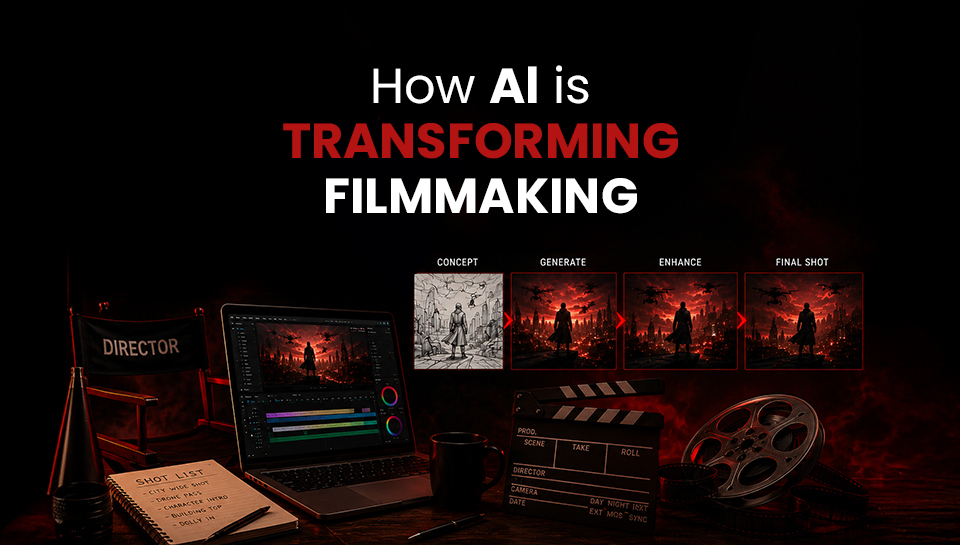
The film industry has always evolved alongside technology. From the transition to sound in the 1920s to the rise of digital cameras and computer-generated imagery (CGI), every technological leap has reshaped how movies are made. Today, artificial intelligence (AI) is poised to be the next major transformation.
Across the industry, filmmakers, studios, and production houses are experimenting with AI in filmmaking to streamline production, improve creative workflows, and unlock entirely new storytelling possibilities. From automated editing systems to generative tools that create visual effects, AI film editing tools are no longer a futuristic concept – they are already part of the modern filmmaking toolkit.
Core entities in the film production line are now making SMART use of AI to streamline their workflows and automate complex tasks. The growing availability of Generative AI(GenAI) and Machine Learning is enabling filmmakers to analyze scripts, generate storyboards, enhance visual effects, and even predict audience preferences. While AI will never replace human creativity, it is rapidly becoming a powerful collaborator that helps filmmakers work faster, smarter, and more creatively.
The Rise of AI in Modern Filmmaking
Artificial intelligence has quietly entered the film industry over the past decade. What began as experimental software for editing and visual effects has evolved into sophisticated systems powered by machine learning, deep learning models, and generative AI.
Today, AI can analyze massive datasets, identify patterns in storytelling, and automate tasks that once required large production teams, thus making content creation much more convenient.
Several major studios and tech entities are investing heavily in AI filmmaking tools. For example:
- Streaming platforms like Netflix and Amazon use machine learning to analyze viewer behavior and guide content development decisions.
- Film studios increasingly rely on AI-powered analytics to estimate box office potential and audience engagement.
- AI-assisted editing tools can now analyze hours of footage and automatically assemble rough cuts.
In fact, according to Deloitte’s industry research, the use of AI film production workflows in the entertainment and media industry has increased significantly over the past five years, with studios using AI for editing, script analysis, and audience prediction.
These developments signal a clear shift: the role of AI in the film industry is moving from supporting to becoming a core component of modern film production. Modern film production services are now using AI tools to enhance the overall effectiveness of the workflow.
How AI Is Changing the Filmmaking Workflow
One of the biggest impacts of AI lies in how it transforms the filmmaking workflow. Traditionally, the film production pipeline is long, consisting of development, pre-production, filming, post-production, and distribution.
AI in film industry is now influencing each stage.
AI in Scriptwriting and Script Analysis
Before a film is even produced, AI can aid in scriptwriting or analyze it to identify elements that influence audience engagement.
AI storytelling in film (by using tools like Squibler) can:
- Generate outlines, character descriptions, and help brainstorm and write full scenes
- Detect pacing issues in scripts
- Identify emotional arcs in dialogue
- Predict audience demographics likely to respond to a story
For example, some studios use AI-based platforms to evaluate scripts by comparing them with thousands of successful films. These systems help producers assess potential risks before investing millions in production.
AI in Pre-Production Planning
Pre-production often involves scheduling shoots, scouting locations, building storyboards, and planning logistics.
AI systems can analyze scripts and automatically generate:
- Shot lists
- Preliminary storyboards
- Location recommendations
- Production schedules
By automating these tasks, filmmakers can spend more time refining creative ideas rather than managing administrative complexity.
AI in Editing and Post-Production
Post-production is one of the most time-consuming phases of filmmaking.
AI video production tools can now assist by:
- Automatically sorting raw footage
- Identifying the best takes
- Generating preliminary edits
Editors can then refine these AI-generated drafts rather than starting from scratch.
This approach can significantly reduce editing timelines, especially for large productions that generate hundreds of hours of footage.
According to McKinsey insights on AI in film production, ‘the greatest near-term value will emerge in pre- and postproduction, which contribute about half of total production spending’.
AI Tools Filmmakers Are Using Today
The rapid growth of machine learning in film production and the emergence of AI editing tools have created a new ecosystem of creative technologies designed specifically for film production.
Here are some of the AI film production tools gaining traction.
Visual artists and production designers often rely on Midjourney to generate concept art, mood boards, and scene visualizations before filming begins, helping directors quickly explore different visual styles.
Similarly, Stable Diffusion is used to create realistic images, previsualizations, and storyboard frames that aid in planning complex scenes.
One of the most widely used tools is Runway ML, which allows editors to remove objects from footage, generate backgrounds, and even create short video sequences using AI video generation technology.
These tools are becoming essential in modern film production because they reduce the time needed for design, editing, and visual experimentation, allowing filmmakers to focus more on storytelling while AI handles many of the technical and repetitive aspects of the production process.
AI in Visual Effects and Cinematography
Visual effects (VFX) have long relied on advanced computing, but AI is dramatically accelerating the process.
AI Visual Effects
Machine learning algorithms can now generate complex visual effects much faster than traditional methods.
AI can assist with:
- Object removal
- Background replacement
- Digital character creation
- Motion tracking
These tools allow smaller studios to produce high-quality visual effects that were previously only possible with large budgets.
AI in Virtual Production
One of the most exciting developments is AI-driven virtual production. It generates synthetic media that can create realistic environments, digital characters, and dynamic backgrounds in real time.
Films and TV series now use LED walls and real-time rendering systems to create digital environments during filming. AI helps optimize lighting, camera tracking, and scene rendering.
A famous example is the production of The Mandalorian, which used advanced virtual production and digital filmmaking technology to create immersive digital worlds.
AI Cinematography Tools
AI-powered cameras aid cinematography by automatically tracking subjects, adjusting exposure, and maintaining focus during complex shots.
This technology helps cinematographers capture dynamic scenes while reducing the time required for technical setup.
How AI Enhances Storytelling and Creativity
A common concern is that AI might make filmmaking more mechanical. In reality, many AI filmmakers are discovering that it enhances, rather than limits, human creativity.
With the integration of AI storytelling in film, the need for the human mind is not eliminated; it is now more focused on its creative side, while the laborious work is handled by artificial intelligence.
This AI-assisted storytelling enables creative experimentation by allowing entities to test ideas quickly.
For example:
- Generating multiple versions of a scene
- Visualizing alternative cinematography styles
- Experimenting with different color grading options
These rapid experiments help in creative direction.
Moreover, AI tools are also lowering barriers for independent filmmakers. Previously, high-end editing software, VFX teams, and production infrastructure required large budgets. Today, AI-powered tools allow small teams—or even individual creators—to produce professional-quality films.
This democratization could lead to a greater diversity of voices and innovative film narratives across the industry.
The Impact of AI on the Future of the Film Industry
The future of filmmaking with AI is likely to extend far beyond production workflows.
AI is already enhancing many production workflows in the media industry, and in the future, it is expected to expand the scale of this impact. According to McKinsey’s study on the potential ways the (film) industry could evolve, ‘approximately $10 billion of forecast US original content spend in 2030 could be addressable by some form of AI’.
Moreover, streaming platforms increasingly rely on data analytics to determine what audiences want. They use AI to analyze streaming behavior, viewer demographics, and social media trends. These insights influence decisions about film genres, casting, and release strategies. An improvement in data-driven content creation would allow the film industry to predict what the audience REALLY wants to see, thereby preventing failures and losses.
As AI adoption grows and film production innovation advances, new professional roles will continue to emerge in the film industry. Examples include:
- AI creative supervisors
- Machine learning specialists in production teams
- AI-assisted editing specialists
Rather than replacing jobs, AI is reshaping skill sets within filmmaking.
Balancing AI Technology With Human Creativity
Even though AI continues to reshape the film, TV, and TVC production industry, it cannot replace human creativity and intelligence. The human mind ought to remain the most powerful tool for film production; thus, AI should be viewed as a tool, not an alternative for human imagination.
Successful filmmakers will likely adopt a balanced approach:
- Use AI to automate technical tasks and aid in creative direction
- Preserve human control over storytelling, film narratives, and artistic decisions
- Maintain ethical standards regarding digital actors and synthetic media
Ultimately, the best films will continue to come from human vision, with AI serving as a powerful creative assistant.
Conclusion
Artificial intelligence is rapidly transforming the filmmaking landscape. From script development to visual effects and audience analytics, generative AI filmmaking is enabling filmmakers to work more efficiently and creatively than ever before.
As AI film production technologies continue to evolve, more and more filmmakers will gain access to increasingly powerful tools that enhance storytelling, reduce production costs, and expand creative possibilities. This will allow many production and content studios to offer AI filmmaking services, helping streamline overall production workflows.
However, the future of filmmaking with AI will depend on maintaining a balance between technology and human creativity, while also considering ethical standards. When used thoughtfully, AI filmmaking tools have the potential to revolutionize the film industry while empowering filmmakers to tell richer, more compelling stories.